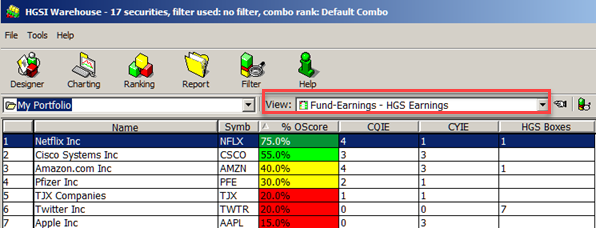
Developed by Ian Woodward, HGS Earnings are a set of data fields used to evaluate stocks on their earnings performance over time. Each of the data fields shown in the table can be used in a HGSI Filter for scanning and/or displayed in a HGSI Warehouse View in a column.
This Warehouse View can be found in the HGSI Software at:
Warehouse Views | HGSI Starters | All Data Fields | Fund-Earnings - HGS Earnings
FILTER |
DATA FIELD |
DESCRIPTION |
COMMENTS |
Yes |
%OScore |
Optic Score |
The percentage score a security obtains by analyzing the current and historical EPS and Revenue of the security for consistent, continuous, consecutive improvements in EPS and Revenue over a period of 8 quarters.
Four individual component scores are computed:
NOTE: Yearly is computed by using current quarter to the same quarter one year ago. The four component scores are summed for each security with a possible max score of 20. The score is turned into a percentage where 20 is 100%, 0 is 0% and everything else is in the middle. |
Yes |
CQIE |
Continuous Quarterly Improvement in Earnings Per Share |
The objective is to find securities with quarter after quarter of continuous EPS growth. The most recent quarter is compared to the preceding quarter. If the most recent quarter is greater than the preceding quarter (not equal), the count is increased by one. This type of backwards comparison where each quarterly EPS is compared to the previous quarterly EPS goes on until one of two events occur:
The counting process results in a number from 0 – 7. A security with consecutive upward progress will get a value of 7 (8 quarters of steady upward progress) A security with a zero means the current quarter is less than the previous quarter.
|
Yes |
CYIE |
Continuous Yearly Improvement in Earnings Per Share |
The objective is to find securities with year after year of continuous EPS growth for the past 3 years. The year is based on a trailing twelve month (TTM) basis. The yearly difference between the most recent EPS quarter and the same quarter a year ago is computed. This backwards computation is done to arrive at 4 yearly EPS values. If the difference for most recent yearly EPS value is greater than the previous year (not equal) we add one to the count. This type of backwards comparison goes on until one of two events occur:
The process results in a number from 0 – 3. A security with consecutive upward yearly progress will get a value of 3 (3 years of steady upward progress).
|
Yes |
HGS Boxes |
High Growth Stock Boxes |
A system that evaluates and rates securities on a scale of 1-10 according to historical earnings growth and places the security into a 10 box matrix based on the rating. Ratings are positive numbers from 1-10. If a security does not meet the earnings criteria for placement into the matrix then it is assigned a ”No Box” rating of 0. (HGS Boxes Calculations)
|
NOTE:
HGSI does its computations and data displays using
GAAP earnings from Zacks which are highly respected earnings. GAAP earnings
are booked or true earnings.
Zacks Investment Research: Stock Research,
Analysis, & Recommendations
GAAP earnings are the generally
accepted accounting principles earnings
IBD, Marketdata and other sites use non-GAAP earnings.
Understanding GAAP vs. Non-GAAP (investopedia.com)